Bible Verses About Grief: Comfort After Losing a Loved One
Last verified: 2026-09-14The fast answer: across Christian traditions, the same small canon of comfort passages serves the grieving — Psalm 23 above all, then John 14:1–3 and Revelation 21:4. Below are those passages with their exact King James text and one line of honest context each, plus what the Bible's genre of lament is, how churches use these verses at funerals, which verses get misused at the graveside, and a short list for sympathy cards. One thing up front: a verse can accompany grief, but it is not a substitute for people, community, or professional help when the loss is crushing. Both can be true at once.
What you will find here
- The comfort passages Christians actually turn to, with exact KJV text
- One line of honest original context per passage — no paraphrase inside quotes
- What the Bible's genre of lament is, and why it legitimizes grief
- How Catholic and Protestant funerals actually use these verses
- Five verses commonly misused at the graveside — with the correctives
- Eleven short verses for sympathy cards, plus a copy-paste card template
Verified September 14, 2026 · In a hurry? Draw a random Bible verse →
01 — The fast answer: the passages people actually turn to
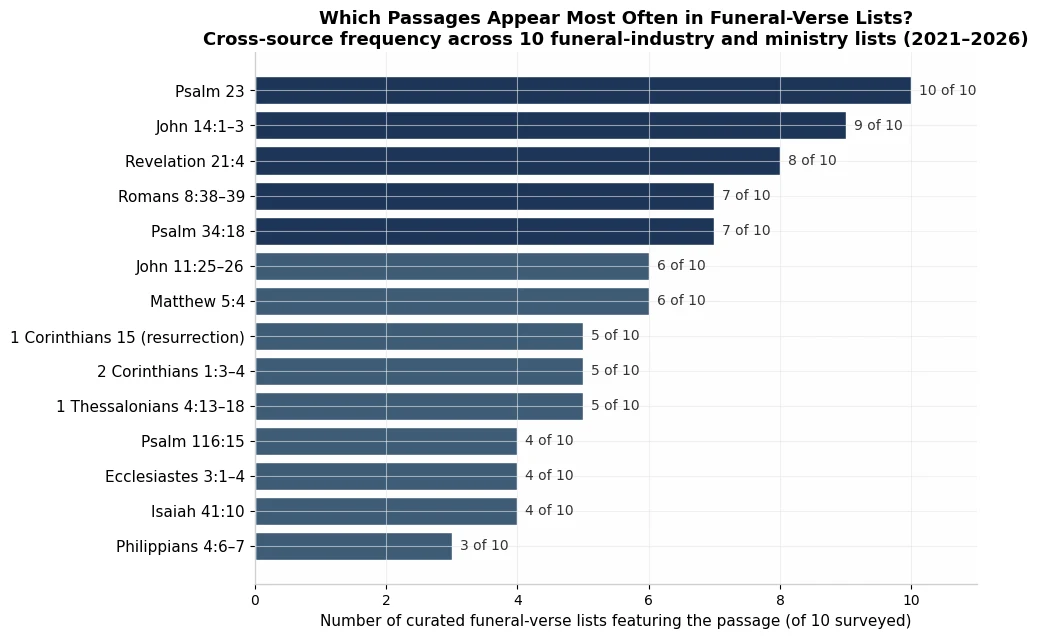
We cross-checked ten funeral-verse lists published between 2021 and 2026 by Bible-study ministries, funeral providers, and officiant resources. The hierarchy is remarkably stable: Psalm 23 appears in all ten lists, John 14:1–3 in nine, and Revelation 21:4 in eight. The industry's largest recurring dataset points the same way from the music side — Co-op Funeralcare's surveys of more than 30,000 funerals have repeatedly found the Psalm 23 hymn "The Lord Is My Shepherd" to be the most-requested funeral hymn in the UK (Classic FM / Co-operative Funeralcare).
Yea, though I walk through the valley of the shadow of death, I will fear no evil: for thou art with me; thy rod and thy staff they comfort me. Psalm 23:4, KJV
And God shall wipe away all tears from their eyes; and there shall be no more death, neither sorrow, nor crying, neither shall there be any more pain: for the former things are passed away. Revelation 21:4, KJV
02 — Psalm 23 and Psalm 34:18: presence in the valley
The Lord is my shepherd; I shall not want. Psalm 23:1, KJV
Psalm 23 was not written as a funeral text — scholars classify it as a psalm of trust, and its "valley of the shadow of death" evokes any mortal danger, not only dying. Its funeral power rests on verse 4's grammar: God accompanies his people through the valley, not around it. That is why it heads the Catholic funeral lectionary's responsorial psalms and anchors the Anglican burial office alike.
The Lord is nigh unto them that are of a broken heart; and saveth such as be of a contrite spirit. Psalm 34:18, KJV
Notice what Psalm 34:18 does not say: it does not promise the brokenhearted will be fixed. It promises God is near to them. Presence first, repair later — that ordering runs through the Bible's whole comfort tradition, and it is why this verse belongs on cards for early, raw grief.
03 — John 14:1–3 and Revelation 21:4: the two great hope passages
Let not your heart be troubled: ye believe in God, believe also in me. In my Father's house are many mansions: if it were not so, I would have told you. I go to prepare a place for you. John 14:1-2, KJV
These words open Jesus' Farewell Discourse, spoken to his disciples in the upper room on the night before his crucifixion — comfort spoken by a man hours from his own death, which is precisely why funeral providers describe it as one of the most frequently chosen Gospel readings. "Mansions" translates a word for dwelling rooms: the promise is a permanent place and reunion in the Father's household.
Revelation 21:4 (quoted in full above) belongs to John's vision of the new heaven and new earth — the climax of the whole Bible's promise, deliberately echoing Isaiah 25:8. Its comfort is deliberately final: not that death is small, but that death is temporary.
04 — Grief with hope: 1 Thessalonians 4, Matthew 5:4, Romans 8
But I would not have you to be ignorant, brethren, concerning them which are asleep, that ye sorrow not, even as others which have no hope. 1 Thessalonians 4:13, KJV
Paul wrote to a young church distressed that some believers had died before Christ's return. He is not forbidding grief — he is contrasting grieving with hope against grieving with none. His stated purpose is pastoral: "Wherefore comfort one another with these words" (4:18). The passage is an appointed funeral reading in the Catholic lectionary for exactly that reason.
Blessed are they that mourn: for they shall be comforted. Matthew 5:4, KJV
For I am persuaded, that neither death, nor life, nor angels, nor principalities, nor powers, nor things present, nor things to come, Nor height, nor depth, nor any other creature, shall be able to separate us from the love of God, which is in Christ Jesus our Lord. Romans 8:38-39, KJV
Matthew 5:4 dignifies mourners instead of rushing them — mourning is named blessed because God's comfort is pledged to it. And note where Paul's great Romans 8 list of powers begins: with death. The funeral application is not an adaptation; it is a direct hit on what Paul meant. The Episcopal Book of Common Prayer opens its burial office with a paraphrase of this very text.
05 — What lament is, and why it matters for grief
The Bible's authority on grief rests not only on its promises but on its portraits. "Lament" is a formal biblical genre — a structured prayer of protest and petition addressed to God from inside catastrophe — and by scholarly counts it is the largest single category in the Psalter: roughly sixty psalms, variously tallied as over one-third to nearly two-thirds of the book. A lament typically moves through an address to God, a complaint, a confession of trust, a petition, and a vow of praise. Psalm 13 begins "How long wilt thou forget me, O LORD? for ever?"; Psalm 22 opens with the cry Jesus quoted from the cross, "My God, my God, why hast thou forsaken me?"; Psalm 88 ends in darkness with no resolution at all. The Bible does not merely permit grief — it scripts it.
Jesus wept. John 11:35, KJV
The shortest verse in the English Bible carries outsized weight: Jesus knew he was minutes from raising Lazarus, and wept at the tomb anyway. The Book of Common Prayer's burial office grounds the legitimacy of Christian grief right here — if the one who was about to abolish this death still mourned it, no mourner needs to apologize for tears.
Job is the long-form version. Losing all ten children, he "rent his mantle, and shaved his head, and fell down upon the ground, and worshipped" (Job 1:20) — performing every customary act of mourning and worshipping in the same motion. His friends begin well, sitting with him in silence for seven days, and go wrong precisely when they start explaining his suffering with tidy theology. God's verdict at the end favors Job's honest protest over the friends' pious speeches (Job 42:7). Even Lamentations — written over the ruins of Jerusalem — produces one of the most-quoted funeral texts of all:
It is of the Lord's mercies that we are not consumed, because his compassions fail not. They are new every morning: great is thy faithfulness. Lamentations 3:22-23, KJV
This is also where our own grieving mood collection comes from: twenty-four hand-picked passages that sit with loss rather than rush it — Psalm 23:4 and Psalm 34:18 from this article among them.
Skip the scroll. Draw a verse matched to how you feel right now.
✦ Get a random Bible verse06 — How churches use these verses at funerals
Catholic funerals do not select readings ad hoc. The Order of Christian Funerals and the Lectionary for Mass provide a fixed menu for Masses for the Dead (lectionary nos. 1011–1016): Old Testament reading, responsorial psalm (Psalm 23 heads the list), New Testament reading (1 Thessalonians 4:13–18 and Romans 8:31b–39 are among the most requested), and Gospel (John 11:17–27, John 14:1–6, the Beatitudes). There is even a separate set of readings for funerals of children, and official policy makes the texts interchangeable "in consultation with the family" — see the full menu catalogued at Catholic Lectionary: Masses for the Dead. In the Anglican tradition, the Book of Common Prayer frames the burial office as "an Easter liturgy," opening with Romans 8. Baptist, Methodist, and non-denominational churches generally select freely — and converge on the same canon: Psalm 23, John 14, Revelation 21.
For printed materials — orders of service, prayer cards, memorial bookmarks — brevity rules. Stationery providers recommend printing in full any verse meant for guests to keep, while a bare reference suffices for a verse that will be read aloud. Translation follows family tradition: the KJV remains the most requested for its familiarity and cadence. All the passages in this article are quoted from the KJV, a public-domain text you can verify at Bible Gateway.
07 — Verses commonly misused at the graveside
For I know the thoughts that I think toward you, saith the Lord, thoughts of peace, and not of evil, to give you an expected end. Jeremiah 29:11, KJV
Jeremiah 29:11 is the paradigmatic misused verse. In context it is a sentence in a letter to the Jewish exiles already deported to Babylon, promising national restoration after seventy years — meaning most of the original hearers would die in exile without seeing it. The "you" is plural, addressed to a nation. Handed to a fresh mourner as "God has a plan," it functions as exactly the platitude grief counselors warn against — GriefShare's "10 things not to say" list includes "God had a plan in this" and "everything happens for a reason." Read rightly, the verse's actual comfort is more honest: God had not abandoned his people in the exile. It is a text about persevering within loss, not escaping it.
| Verse (KJV) | Common misuse at the graveside | What the context actually supports |
|---|---|---|
| Romans 8:28 — "all things work together for good" | Quoted within hours of a death as "everything happens for a reason" | The "good" is defined in the next verse as conformity to Christ's image, in a passage that openly names present suffering; a promise about the end, not an explanation of the death |
| 1 Thessalonians 4:13 — "sorrow not" | Read as a command not to grieve | Paul contrasts grieving with hope against grieving without it; Jesus himself wept |
| Psalm 30:5 — "joy cometh in the morning" | Used to predict a short grief timeline | A retrospective thanksgiving after deliverance, not a schedule; grievers report it landing as a demand to hurry |
| Philippians 4:13 — "I can do all things through Christ" | Quoted as a grit-your-teeth resilience slogan | In context (4:11–12) Paul describes having learned contentment in hunger and need — about enduring, not achieving |
| 1 Corinthians 10:13 — "tempted above that ye are able" | Paraphrased as "God never gives you more than you can handle" | The verse concerns temptation to sin and the way of escape, not a ceiling on bereavement |
Bottom line: a verse's timing and posture matter as much as its content. Even true and beloved verses wound when deployed prematurely — one widow told GriefShare that friends quoting Psalm 30:5 in the first days after her husband's death "felt harmful because they didn't understand the depth of loss." Lead with presence and lament; let the comfort texts speak when the mourner is ready to hear them.
08 — Short Bible verses for sympathy cards and memorization
These KJV texts are short enough to memorize in minutes and are the ones pastors and funeral-stationery providers most often recommend for cards, programs, and bookmarks. A practical rule of thumb: for the first days, choose verses that sit with the mourner; reserve the future-oriented promises for later moments when the mourner reaches for them.
- John 11:35 — "Jesus wept." Validates tears; the shortest verse in the Bible.
- Matthew 5:4 — "Blessed are they that mourn: for they shall be comforted." The classic sympathy-card verse.
- Psalm 34:18 — "The Lord is nigh unto them that are of a broken heart; and saveth such as be of a contrite spirit." For early, raw grief.
- Psalm 147:3 — "He healeth the broken in heart, and bindeth up their wounds." For the weeks after the funeral.
- Psalm 46:1 — "God is our refuge and strength, a very present help in trouble." For crises; easy to memorize.
- Psalm 56:8 — "Thou tellest my wanderings: put thou my tears into thy bottle: are they not in thy book?" For someone ashamed of crying.
- Psalm 116:15 — "Precious in the sight of the Lord is the death of his saints." For the funeral of a believer.
- John 16:22 — "And ye now therefore have sorrow: but I will see you again, and your heart shall rejoice, and your joy no man taketh from you." Hope of reunion.
- Philippians 4:7 — "And the peace of God, which passeth all understanding, shall keep your hearts and minds through Christ Jesus." For anxious mourners.
- Lamentations 3:22-23 — "It is of the Lord's mercies that we are not consumed, because his compassions fail not. They are new every morning: great is thy faithfulness." For the long middle of grief.
- Revelation 21:4 — "And God shall wipe away all tears from their eyes; and there shall be no more death, neither sorrow, nor crying, neither shall there be any more pain: for the former things are passed away." A closing reading, or a card for anniversaries.
A sympathy card works best when the verse is wrapped in one personal sentence — grief counselors consistently warn against a bare verse doing all the talking. Copy this template and replace the bracketed parts:
Dear [first name],

I am so sorry about [loved one's name]. I keep remembering
[one specific memory or quality], and I am holding you in
my prayers.

"[Short verse from the list above]" — [Reference]

No need to reply. I will drop off dinner on [day].
[Your name]
Note what the template deliberately avoids: no "everything happens for a reason," no "I know how you feel," and a specific offer of help instead of "let me know if you need anything" — the three patterns GriefShare's counselors flag as wounding.
09 — An honest pastoral note
A verse is not a substitute for support, community, or professional help, and we will not pretend otherwise. The consistent testimony of grief-support organizations is that the bereaved are helped less by explanations than by accompaniment: people who acknowledge the loss by name, listen without redirecting, allow tears, and bring specific practical help. Scripture's own pattern agrees — Job's friends did their best work in the seven days they said nothing. So use these verses as companions: read them, pray them, print them on the card. And if your grief is persistent or crushing, please also reach for a grief-support group, your own faith community, a doctor, or a licensed counselor. That is not a lack of faith; it is taking both gifts seriously.
Draw a random Bible verse
- One hand-picked passage at a time, no noise
- KJV, WEB, and ASV side by side
- Free, public-domain text — print it anywhere
Or browse the grieving collection
- 24 passages curated specifically for loss
- Including Psalm 23:4 and Psalm 34:18 above
- Nothing here will rush you
FAQ
What is the most comforting Bible verse when someone dies?
Psalm 23 is the passage turned to most — it appears in every one of the ten funeral-verse lists we surveyed, and its fourth verse promises God's presence 'through the valley of the shadow of death,' not around it. For a single sentence of hope, John 14:2 ('In my Father's house are many mansions') is the most-chosen Gospel reading at Christian funerals.
What is a good short Bible verse for a sympathy card?
Matthew 5:4 is the classic: 'Blessed are they that mourn: for they shall be comforted.' For raw, early grief, Psalm 34:18 ('The Lord is nigh unto them that are of a broken heart') sits with the mourner instead of rushing them. Print the verse in full on a card the person will keep; a reference alone is enough on a program.
Is it wrong for a Christian to grieve deeply?
No. Paul never forbids grief — he contrasts grieving with hope against grieving 'as others which have no hope' (1 Thessalonians 4:13). And John 11:35 records that Jesus wept at his friend's tomb moments before raising him: the one who was about to abolish that death still mourned it. Deep grief and real faith are not competitors.
Is it wrong to feel angry at God while grieving?
No — the Bible's own prayer book gives anger authorized language. Roughly a third of the Psalms are laments, including protests like 'How long wilt thou forget me, O LORD?' (Psalm 13:1), and Psalm 88 ends in unresolved darkness. Job argued with God for chapters and was vindicated over his pious friends (Job 42:7). Anger addressed to God is still prayer; the lament genre exists precisely for it.
What does 'Jesus wept' mean for someone who is mourning?
John 11:35 — the shortest verse in the English Bible — means tears are not a faith failure. Jesus knew he was minutes from raising Lazarus and wept anyway, standing with Mary in her grief before he fixed it. It gives mourners permission to cry, and gives comforters a model: presence before solutions.
Should I quote Jeremiah 29:11 to someone who is grieving?
Usually no, at least not in the first days. In context it is God's promise to a nation in exile that restoration would come after seventy years — most original hearers would not live to see it. Handed to a fresh mourner as 'God has a plan,' grief counselors warn it lands as a platitude that minimizes the loss. Its honest comfort is slower: God had not abandoned his people inside the exile.
Which Bible verses are read most often at funerals?
Across Catholic and Protestant practice the same canon recurs: Psalm 23, John 14:1–3, Revelation 21:4, Romans 8:38–39, and 1 Thessalonians 4:13–18. Catholic funerals choose from a fixed menu in the Lectionary for Mass (nos. 1011–1016); Anglican services draw on the Book of Common Prayer; other Protestant churches select freely — and converge on the same texts.
How much of the Book of Psalms is lament?
Depending on the classification scheme, scholars count roughly sixty psalms as laments — variously described as over one-third to nearly two-thirds of the Psalter, making lament its largest single category. That means the Bible's own prayer book gives grief, protest, and even abandonment ('Why hast thou forsaken me?') authorized, scripted language.
Can Bible verses replace grief counseling or therapy?
No, and this site will not claim otherwise. Verses are companions in grief, not treatment for it. If your grief is persistent, crushing, or interfering with daily life, please also talk to a doctor, a licensed counselor, or a grief-support group — bringing the verses with you, not instead of help.
What should I say to a grieving friend instead of quoting a verse?
Grief-support organizations are consistent: acknowledge the loss by name, listen without redirecting to your own story, allow tears, and offer specific practical help ('I'll bring dinner Tuesday') rather than open-ended offers. Avoid 'everything happens for a reason' and 'I know how you feel.' Total silence wounds too — say something simple and true.
Which translation is best for funeral readings — KJV, WEB, or ASV?
Follow the family's tradition. The KJV remains the most requested for its familiarity and cadence — 'the valley of the shadow of death' is how most mourners know Psalm 23. The WEB and ASV say the same things in plainer English and work well when the hearers are not KJV-raised. All three are public domain, so any of them can be printed freely on programs and cards.